EngliSea > math > Analysis in Inline Notation > 5 Continuous Functions
 
○○○ 5.1.1 Definition ⎾lim f(x)⏐x→∞⏌= L ⪢⪢
f(x) tends to L as x tends to infinity, if for every ε>0 there exists a real number X such that x>X ⇒ ⎹f(x)−L⎸<ε.
39169#5002 SBLNGS CHLDRN 5002
 
○○○ 5.1.2 Definition ⎾lim f(x)︱x→a⏌= L ⪢⪢
⎾lim f(x)︱x→a⏌= L if and only if for every ε>0 there exists a δ>0 such that 0<⎹x−a⎸<δ ⇒ ⎹f(x)−L⎸<ε.
39169#5003 SBLNGS CHLDRN 5003
 
○○○ 5.1.3 Sum/product/quotient rule ⪢⪢
Suppose that ⎾lim f(x)⏐x→a⏌= L and ⎾lim g(x)⏐x→a⏌= M. Then the following rules apply. ❶ Sum Rule ⎾lim f(x)+g(x)⏐x→a⏌= L+M ❷ Product Rule ⎾lim f(x)·g(x)⏐x→a⏌= L·M ❸ Quotient Rule ⎾lim f(x)/g(x)⏐x→a⏌= L/M, provided that M≠0.
39169#3803 SBLNGS CHLDRN 3803
 
○○○ 5.1.4 Sandwich rule ⪢⪢
Let f, g and h be functions such that f(x)≤g(x)≤h(x) in some deleted neighborhood of c. If ⎾lim f(x)⏐x→c⏌=⎾lim h(x)⏐x→c⏌= L then ⎾lim g(x)⏐x→c⏌= L.
39169#3422 SBLNGS CHLDRN 3422
 
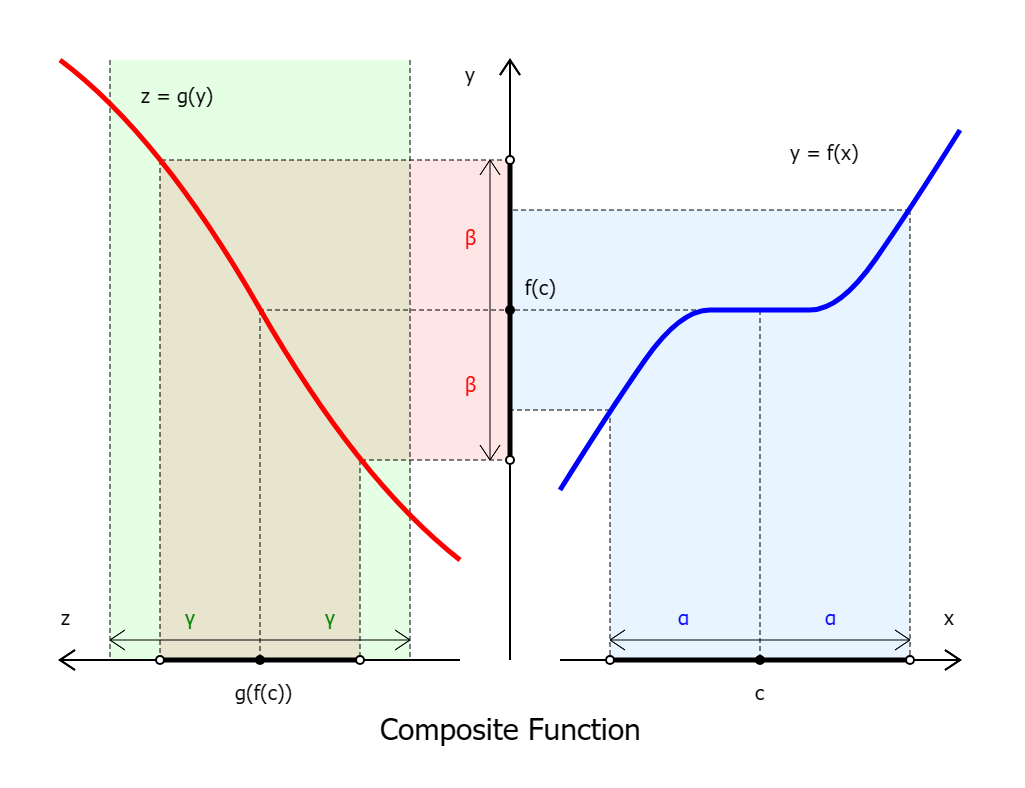
5.1.5 Composite Functions
• 5.1.5 Composite Functions
39169#9673 SBLNGS CHLDRN 9673
 
○○○ 5.1.5 Composite Functions ⪢⪢
If the range of f does not include the deleted neighborhood of f(c), the limit of the composite function g∘f at c cannot be defined.
39169#9757 SBLNGS CHLDRN 9757
 
○○○ 5.1.5 Composite rule ⪢⪢
If ⎾lim f(x)⏐x→c⏌= L and ⎾lim g(x)⏐x→L⏌= M and the deleted neighborhood of L is in the range of f. Then ⎾lim (g∘f)(x)⏐x→c⏌= M.
39169#3424 SBLNGS CHLDRN 3424
 
○○○ 5.1.6 Left and Right Theorem ⪢⪢
⎾lim f(x)⏐x→a⏌= L ⇔ ⎾lim f(x)⏐x→a⁻⏌=⎾lim f(x)⏐x→a⁺⏌= L
39169#3421 SBLNGS CHLDRN 3421
 
○○○ 5.2.1 Definition "continuous at c" ⪢⪢
f is continuous at c if and only if ⎾lim f(x)⏐x→c⏌= f(c).
39169#5001 SBLNGS CHLDRN 5001
 
○○○ 5.2.3 Left and Right Theorem ⪢⪢
f is continuous at c if and only if f is both left-continuous and right-continuous at c. If ⎾lim f(x)⏐x→c⁻⏌ exists and equals f(c) then f is left-continuous at c. If ⎾lim f(x)⏐x→c⁺⏌ exists and equals f(c) then f is right-continuous at c.
39169#5123 SBLNGS CHLDRN 5123
 
○○○ 5.2.4 Sum/product/reciprocal rules ⪢⪢
Sum rule. If f and g are continuous at c then f+g is continuous at c.┆Product rule. If f and g are continuous at c then f·g is continuous at c.┆Reciprocal rule. If f is continuous at c and f(c) is not 0 then 1/f is continuous at c.
39169#5158 SBLNGS CHLDRN 5158
 
○○○ 5.2.5 Sandwich rule ⪢⪢
Let f, g and h be functions such that f(x)≤g(x)≤h(x) in some neighborhood of c and such that f(c)=g(c)=h(c). If f and h are conyinuous at c, then so is g.
39169#5160 SBLNGS CHLDRN 5160
 
5.2.6 Composite  rule
• 5.2.6 Composite rule
39169#9672 SBLNGS CHLDRN 9672
 
○○○ 5.2.6 Composite rule ⪢⪢
If f and g are continuous at c and f(c) respectively and the deleted neighborhood of f(c) is in the range of f. Then g∘f is continuous at c.
39169#3734 SBLNGS CHLDRN 3734
 
○○○ 5.2.7 Inverse rule ⪢⪢
Suppose that f:A→B is a bisection where A and B are intervals. If f is continuous on A, then f˂ is continuous on B.
39169#5163 SBLNGS CHLDRN 5163
 
○○○ 5.3.1 The boundedness property ⪢⪢
Let f be continuous on the interval [a,b]. Then (1) f is bounded on [a,b], (2) f attains both a maximum value and a minimum value somewhere on [a,b].
39169#4816 SBLNGS CHLDRN 4816
 
○○○ 5.3.2 The intermediate value property ⪢⪢
Let f be continuous on the interval [a,b] and suppose that f(a)=α and f(b)=β. For every real number γ between α and β there exists a number c, a<c<b, with f(c)=γ.
39169#4822 SBLNGS CHLDRN 4822
 
○○○ 5.3.3 The interval theorem ⪢⪢
Let f be continuous on [a,b]. Then f([a,b]) is a closed bounded interval.
39169#4996 SBLNGS CHLDRN 4996
 
Pillow English Listening
 
○○○ 5.3.4 A fixed point theorem ⪢⪢
Let f: [0,1] → [0,1] be a continuous function. Then there is at least one number c that is fixed by f. That is, f(c)=c.
39169#4997 SBLNGS CHLDRN 4997

-