
•
+addition┆−subtraction
Addition and Subtraction
➊ Natural numbers are closed under addition.
➋ Subtraction is the inverse operation of addition.
p + q = r ┆ r - q = p ┆ r - p = q
If p or q is greater than or equal to r, the result is not a natural number.
By including 0 and ...
5216#17366
SBLNGS
CHLDRN
17366
•
·multiplication┆/division
Multiplication and Division
➌ Multiplication is repeated addition.
p + p + p = p·3
p·0 means 'adding p zero times', which is 0.
If we define p·(-q) as 'subtracting p q times', then integers are closed under multiplication too.
➍ Division is the inverse ...
5216#5017
SBLNGS
CHLDRN
5017
•
˄exponentiation┆˅root
Exponentiation and Root
➎ Exponentiation is repeated multiplication.
p · p · p = p ˄ 3
p ˄ 1 means 'multiplying p one time', which means 'adding p one time', that is p.
(p˄m)·(p˄n) = p˄(m+n)
(p˄m)˄n = p˄(m·n)
(p·q)˄n = (p˄n)·(q˄n)
➏ Root is the invers ...
5216#39179
SBLNGS
CHLDRN
39179
 •
˄exponentiation┆˅root
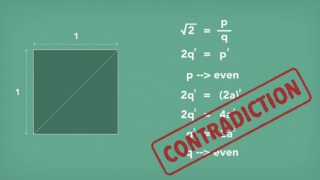
According to Pythagoras theorem the diagonal length of a square with each side measuring one unit would be square root of two.
The assumption that square root of two could be expressed as a ratio of two integers deduces a contradiction.
5216#9736
SBLNGS
CHLDRN
9736
•
˄exponentiation┆⍻logarithm
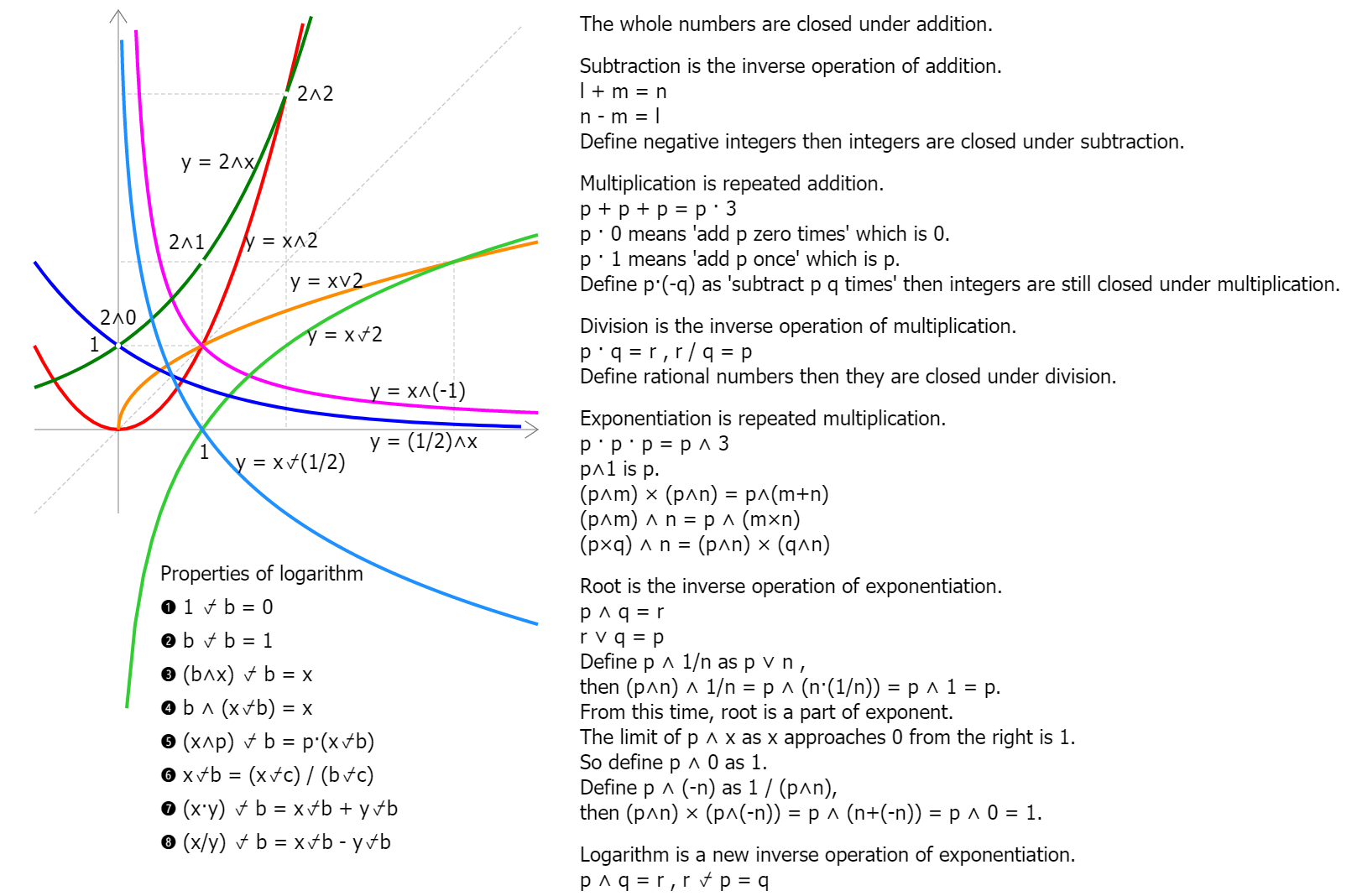
❽ Logarithm is the inverse operation of exponentiation.
p ˄ q = r ┆ r ⍻ p = q
① 1⍻p = 0 ② p⍻p = 1 ③ (p˄x)⍻p = x ④ p˄(x⍻p) = x
⑤ (x˄q)⍻p
= ( (p˄(x⍻p) )˄q)⍻p ∵□=p˄(□⍻p)
= ( p˄((x⍻p)·q) )⍻p ∵(p˄□)˄p=p˄(□·p)
= (x⍻p)·q ∵(p˄□)⍻p=□
= q·(x⍻p)
x⍻c
= ( p˄(x⍻p) )⍻ ...
5216#39180
SBLNGS
CHLDRN
39180

-


 ◌◌◌
Exponentiation
 ◌◌◌
Logarithm