EngliSea > math > Analysis in Inline Notation > 6 Differentiation
 
○○○ 6.1.1 Definition "differentiable at c" ⪢⪢
f is differentiable at c if and only if ⎾lim ( f(x)-f(c) )/(x-c)⏐x→c⏌ exists.
3533#3797 SBLNGS CHLDRN 3797
 
○○○ 6.1.2 Theorem ⪢⪢
If f is differentiable at c then f is continuous at c.
3533#5081 SBLNGS CHLDRN 5081
 
○○○ 6.1.3 Sum rule of differentiation ⪢⪢
If f and g are differentiable at c then f+g is differentiable at c and (f+g)(c)ᐁx = f(c)ᐁx + g(c)ᐁx.
3533#9635 SBLNGS CHLDRN 9635
 
○○○ 6.1.3 Product rule of differentiation ⪢⪢
If f and g are differentiable at c then f·g is differentiable at c and (f·g)(c)ᐁx = f(c)·g(c)ᐁx + f(c)ᐁx·g(c).
3533#9620 SBLNGS CHLDRN 9620
 
○○○ 6.1.3 Reciprocal rule of differentiation ⪢⪢
If f is differentiable at c and f(c) is not 0 then 1/f is differentiable at c and (1/f)(c)ᐁx = -f(c)ᐁx/f²(c).
3533#9619 SBLNGS CHLDRN 9619
 
○○○ 6.1.4 Quotient rule of differentiation ⪢⪢
If f and g are differentiable at c and g(x) is not 0 then f/g is differentiable at c and (f/g)(c)ᐁx = ( f(c)ᐁx·g(c)−f(c)·g(c)ᐁx )/g²(c).
3533#9651 SBLNGS CHLDRN 9651
 
○○○ 6.1.5 Sandwich rule ⪢⪢
Let f, g and h be functions such that f(x)≤g(x)≤h(x) for all x in some neighborhood of c and such that f(c)=g(c)=h(c). If f and h are differentiable at c, then so is g and f(c)ᐁx = g(c)ᐁx = h(c)ᐁx.
3533#6085 SBLNGS CHLDRN 6085
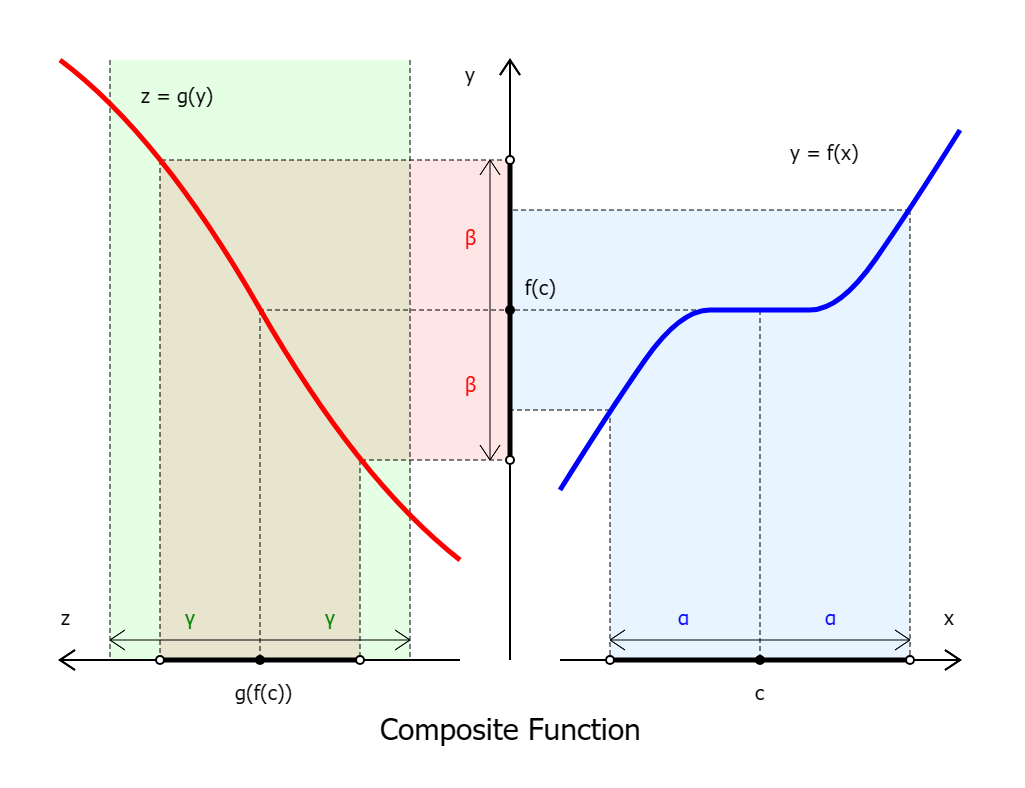
 
6.1.6 Composite  rule
• 6.1.6 Composite rule
3533#9687 SBLNGS CHLDRN 9687
 
Songs in Easy English
 
○○○ 6.1.6 The composite rule for differentiation ⪢⪢
If f and g are differentiable at c and f(c) respectively and the deleted neighborhood of f(c) is in the range of f. Then g∘f is differentiable at c and (g∘f)(x)ᐁx[c] = g(x)ᐁx[f(c)]·f(x)ᐁx[c].
3533#9666 SBLNGS CHLDRN 9666
 
○○○ 6.1.7 The inverse rule for differentiation ⪢⪢
If f and g are differentiable at c and f(c) respectively and the deleted neighborhood of f(c) is in the range of f. Then g∘f is differentiable at c and (g∘f)(x)ᐁx[c] = g(x)ᐁx[f(c)]·f(x)ᐁx[c].
3533#10488 SBLNGS CHLDRN 10488
 
○○○ 6.1.8 The local maximum/minimum values ⪢⪢
A function f has a local maximum value at c if c is contained in some open interval for which f(x)≤f(c) for any x in that interval. If f(x)≥f(c) for any x the interval then f has a local minimum value at c.
3533#20672 SBLNGS CHLDRN 20672
 
○○○ 6.1.9 The Local Extremum Theorem ⪢⪢
If f is differentiable at c and possesses a local maximum or a local minimum at c then f(x)ᐁx[c] is 0.
3533#23529 SBLNGS CHLDRN 23529
 
○○○ 6.2.1 Rolle's Theorem ⪢⪢
Let f be differentiable on (a,b) and continuous on [a,b]. If f(a)=f(b) then there exists a c, a<c<b, such that f(x)ᐁx[c]=0.
3533#23531 SBLNGS CHLDRN 23531

-